24/7 Patient Support Chatbot: Implementation Guide for Hospitals
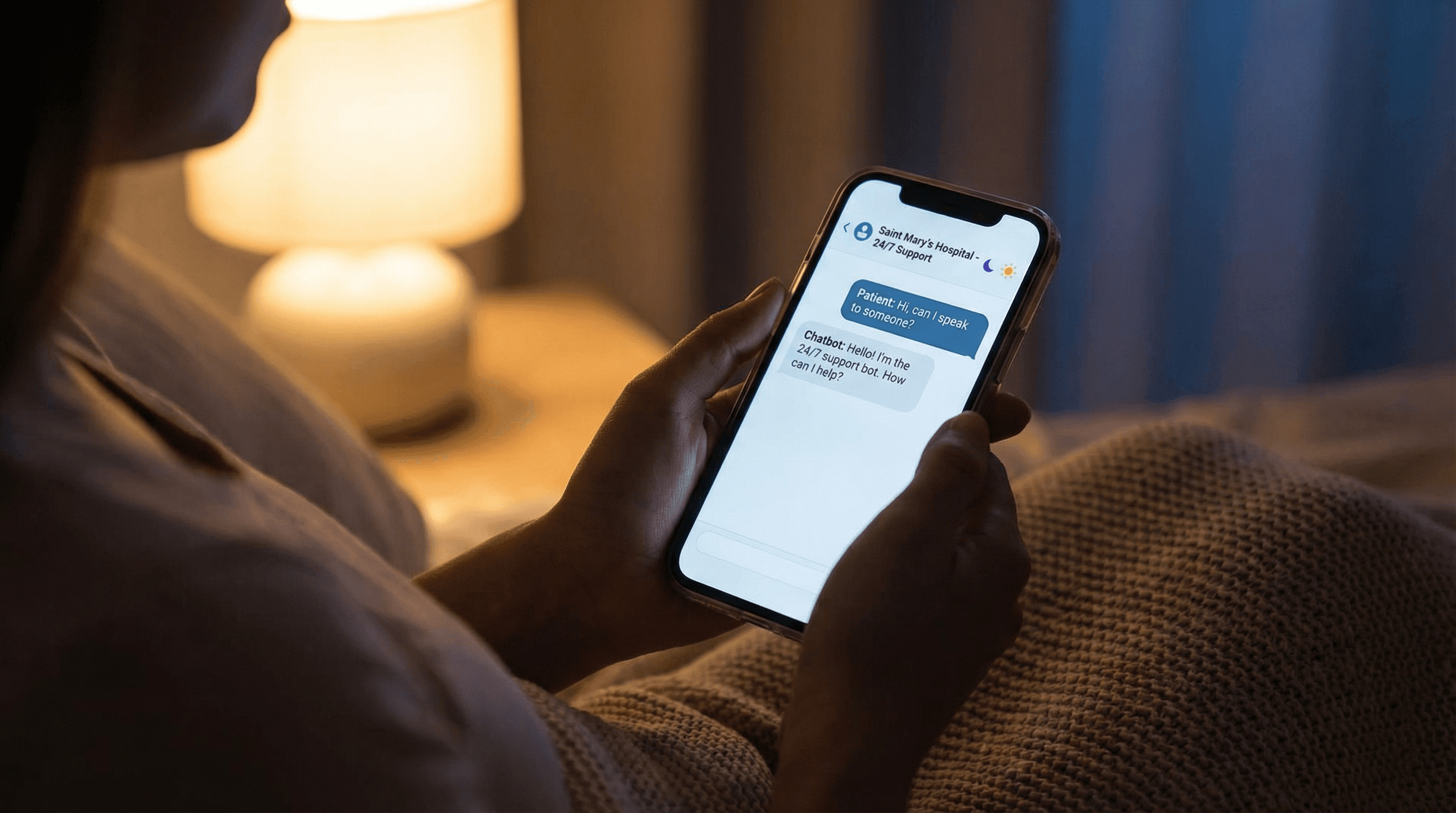
It was 11:47 PM when Mr. Lim decided he couldn't sleep anymore. His father's colonoscopy was scheduled for tomorrow morning, and he suddenly couldn't remember the fasting instructions. Was it 8 hours before? 12 hours? Could his dad take his heart medication?
He called the hospital. Automated message: "Our office hours are 8 AM to 6 PM Monday through Friday. Please call back during business hours."
By morning, he was panicked enough to call three times before someone answered. Turns out his dad had followed the wrong instructions and the procedure had to be rescheduled.
"If only someone had been there at midnight," Mr. Lim said later. "Just to answer a simple question."
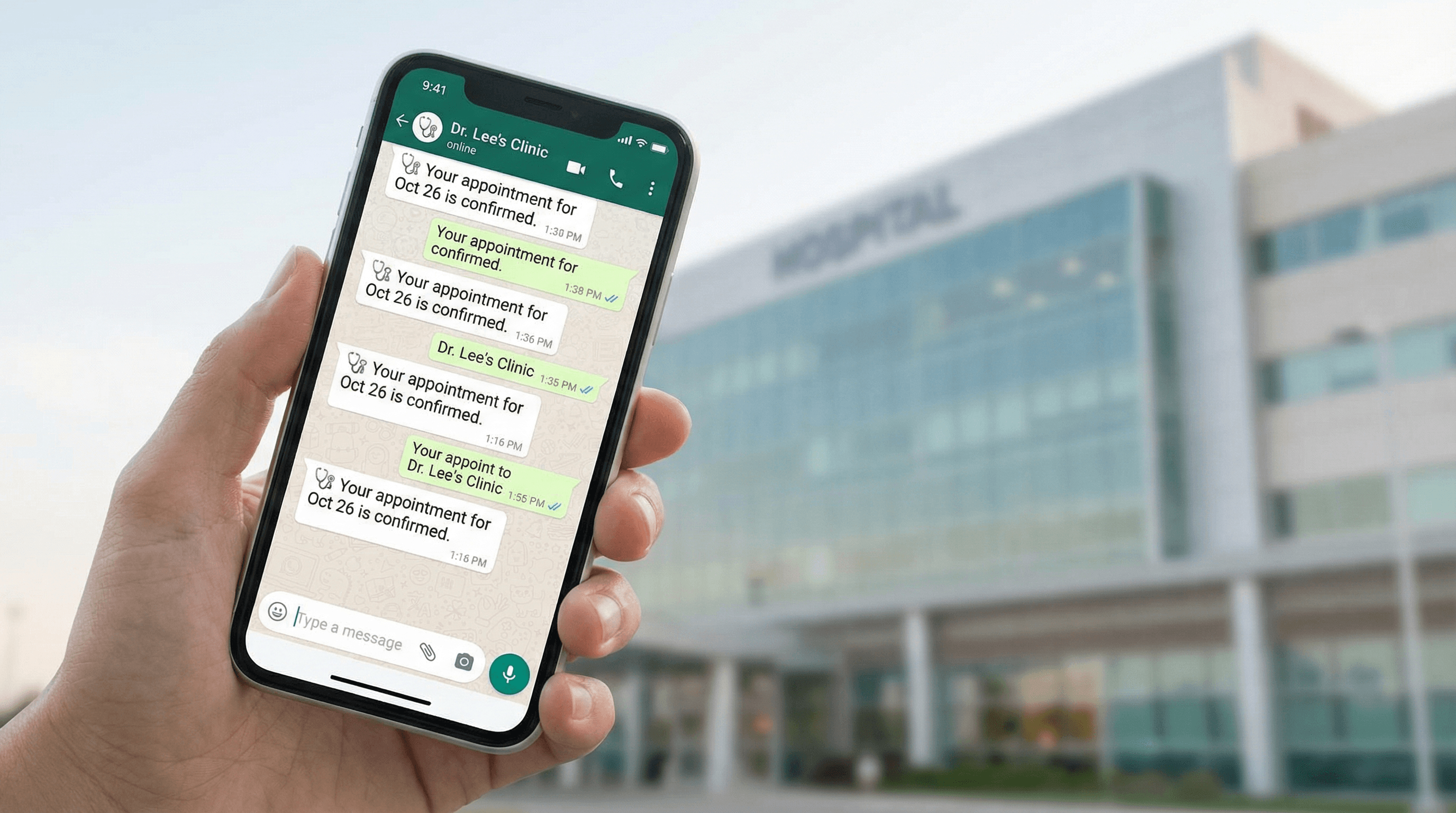
Now imagine this: at 11:47 PM, Mr. Lim sends a WhatsApp message instead. Within 8 seconds, he gets a response with exactly the prep instructions he needs, specific to his father's procedure and medication situation.
That's not the future. That's what's happening right now at hospitals that have deployed 24/7 AI support.
The Invisible Revenue You're Losing
Here's a calculation that should make any hospital CFO uncomfortable:
Your hospital receives 500 calls per day. That's a typical number for a mid-sized institution.
35% of those calls happen after hours — when nobody answers. That's 175 calls per day.
Of those 175 after-hours callers:
- 40% have questions a chatbot could answer instantly
- 25% wanted to book appointments
- 60% of unanswered callers never try again
Let's do the math on just the appointment seekers:
- 175 calls × 25% booking intent = 44 potential appointments daily
- 44 × $150 average appointment value = $6,600 per day at risk
- Annualized: $2.4 million in potentially lost revenue
And that's before accounting for the patients who went to competitors because you weren't available when they needed you.
A Night in the Life of AI Support
Let me show you what 24/7 support actually looks like in practice:
9:17 PM — The Worried Parent
Mrs. Chen's son has a sports injury appointment tomorrow. She messages on WhatsApp: "Do we need to bring any documents or X-rays?"
AI responds within 5 seconds: "Hi Mrs. Chen! For Kevin's appointment tomorrow with Dr. Singh at 10:30 AM, please bring: any previous X-rays or MRI images, your insurance card, and a list of current medications. Would you like me to send you a reminder in the morning?"
She replies "yes" and goes to bed without anxiety.
11:34 PM — The Midnight Booker
A new patient in pain finds your hospital website. They click "Send Message" on WhatsApp. "I've been having terrible back pain. Can I see someone this week?"
The AI: "I'm sorry to hear you're in pain. Dr. Wong, our spine specialist, has availability Thursday at 2 PM or Friday at 9 AM. Would either of those work for you?"
Patient books the Thursday slot. Without AI, that patient would have called a competitor in the morning.
2:48 AM — The Post-Procedure Concern
Mr. Tan had a dental procedure yesterday. He wakes up with mild bleeding from the site. Is this normal?
He messages the hospital. The AI asks about severity, duration, and other symptoms. Based on his answers, it reassures him that minor bleeding is normal in the first 24-48 hours, provides guidance on managing it, and asks if he'd like a callback from the nurse line when it opens.
Without AI, he might have gone to the ER—or ignored something that needed attention.
6:15 AM — The Early Riser
Mrs. Patel is up early and remembers she needs to reschedule her appointment. She doesn't want to wait until 8 AM.
"Can I reschedule my Thursday appointment to next week?"
The AI looks up her appointment, shows available slots for the following week, and completes the rescheduling—all before the call center opens.
What AI Handles vs. What Humans Handle
Not everything should be automated. Here's how successful hospitals divide the work:
Tier 1: AI Handles 100%
Information queries:
- Operating hours, location, parking
- Services offered, doctor profiles
- Insurance accepted
- Visitor policies
- General preparation instructions
These questions have definitive answers. There's no reason a human should spend 3 minutes on the phone for "What time do you close?"
Standard transactions:
- Appointment booking (with real-time availability)
- Rescheduling and cancellations
- Joining waitlists
- Sending reminders and confirmations
Tier 2: AI Handles 80%+, Escalates Rest
Personalized information:
- Specific prep instructions for scheduled procedures
- Post-visit care questions
- Insurance coverage inquiries (connected to patient records)
The AI handles most cases automatically but recognizes when something needs human judgment.
Tier 3: AI Triages, Humans Handle
Clinical concerns:
- Symptom assessment (AI gathers info, human decides)
- Medication questions (AI routes to pharmacist)
- Test result discussions (AI notifies, human explains)
- Urgent care decisions (AI triages, escalates appropriately)
The AI's job here isn't to give medical advice—it's to gather information efficiently so humans can act quickly.
The Implementation Reality
Let me be honest about what implementation actually involves:
Weeks 1-3: Foundation
What happens:
- Audit your top 100 call center questions
- Write AI-friendly responses for each
- Map conversation flows
- Connect to scheduling system
What you need:
- 2-4 hours from operations lead
- IT support for system connections
- Content approval from clinical team
Weeks 4-6: Soft Launch
What happens:
- Deploy on website chat first
- AI handles FAQ only
- Human agents monitor every conversation
- Refine responses based on real queries
What you learn:
- Which questions patients actually ask (surprise: not what you expected)
- Where AI gets confused
- What's missing from your content
Weeks 7-10: Expansion
What happens:
- Enable appointment booking
- Add WhatsApp channel
- Reduce human monitoring
- Extend to after-hours coverage
What changes:
- Staff start trusting the AI
- Patients start preferring it for routine queries
- Call volume begins declining
Month 3+: Optimization
What happens:
- Add patient authentication for personalized queries
- Enable lab result notifications
- Add proactive reminders
- Multi-language support
The plateau:
- AI handles 70-80% of routine inquiries
- Humans focus on complex cases
- Costs drop while satisfaction rises
The Metrics That Matter
After implementation, track these to prove ROI:
Operational
| Metric | Target | Why It Matters |
|---|---|---|
| Containment rate | 70%+ | Queries resolved without human |
| First response | <10 sec | Patient experience driver |
| Resolution time | <3 min | Efficiency measure |
| Handover rate | <30% | AI effectiveness |
Patient Experience
| Metric | Before AI | After AI |
|---|---|---|
| Average wait for answer | 12+ min | <10 sec |
| After-hours availability | 0% | 100% |
| Patient satisfaction | 72 NPS | 85+ NPS |
Financial
| Metric | Impact |
|---|---|
| After-hours bookings captured | +$200K-500K/year |
| Call center efficiency | +40-60% |
| Cost per interaction | -60% |
Why Most Chatbots Fail (And How to Avoid It)
I've seen plenty of failed chatbot implementations. Here's what goes wrong:
Failure 1: Trying to do everything at once
A hospital wanted AI to handle scheduling, triage, billing, and everything else from day one. Result: none of it worked well. Patients were frustrated. Staff didn't trust it.
Solution: Start with FAQ and basic scheduling. Add capabilities only after the foundation is solid.
Failure 2: Using generic AI
A hospital deployed a general-purpose chatbot trained on customer service conversations. When a patient asked about fasting before surgery, it gave advice about restaurant reservations.
Solution: Use AI trained specifically on healthcare conversations. Medical terminology, clinical protocols, and sensitivity to health concerns matter.
Failure 3: Invisible handoffs
A patient started with the chatbot, got transferred to a human, and had to repeat everything. Then got transferred again. And again.
Solution: When AI hands off to humans, all context must transfer with it. The human should see the full conversation history.
Failure 4: No escalation for urgency
A patient reported chest pain to a chatbot that kept asking about appointment preferences.
Solution: AI must recognize clinical urgency and immediately route to appropriate resources (nurse line, ER direction, emergency services).
What Good Looks Like
At hospitals doing this well:
- 70-80% of routine inquiries handled without human intervention
- <10 second response time, 24/7
- Zero urgent clinical queries left hanging
- 35%+ of bookings happen after hours
- Staff freed to focus on cases that need human judgment
- Patients prefer the AI for routine queries (faster, easier)
Your Next Step
Bot MD provides healthcare-specific 24/7 AI support with:
- Healthcare-trained AI that understands medical context
- Omnichannel deployment: WhatsApp, web chat, SMS, Messenger
- Deep integration with scheduling, HIS, and EMR systems
- Intelligent escalation that routes urgent concerns appropriately
- HIPAA and PDPA compliance built in
Book a demo to see what 24/7 patient support looks like in practice. We'll show you exactly how hospitals like yours capture after-hours revenue, reduce call center burden, and improve patient satisfaction—all at once.
Mr. Lim's father shouldn't have to reschedule a procedure because nobody answered a simple question at midnight. Neither should your patients.